
Understanding Coleman County Releases
For Coleman County released inmates, “release record” is a practical label, not the title of one standard county document. Proof may be a release-date field in the jail system, a completed booking-out entry, a movement log, a bond record, a court order, or an answer to a public-information request. Each source proves a different fact. The Coleman County Sheriff's Office links to an online custody list for people displayed in the county facility now. Once a person leaves that live list, the release evidence usually remains with the sheriff, a court clerk, TDCJ, or the agency that received a transfer.
A local custody episode may end through bond, dismissal, a court release order, time served, sentence completion, or movement to another authority. Only some outcomes mean the person returned to the community. A transfer to another county, delivery to TDCJ, or action on a federal or immigration hold continues custody. Parole and mandatory supervision concern release from TDCJ confinement under supervision. Probation, also called community supervision, is imposed by a court and may occur without a prison stay. The record and agency must match the event being checked.
Coleman County Release Paths
The Coleman County Law Enforcement Center holds people awaiting court action, serving qualifying county sentences, or being held for another authority. The public detail record may supply dates and bond facts, but it does not present one normalized “release reason” field. Never turn a date alone into a claim that charges were dismissed or a person bonded out. Match it with the bond order, court docket, or movement entry.
| Custody outcome | What it means | Best next source |
|---|---|---|
| Bond or personal bond | The county custody episode ends while the case may remain open. | Jail release entry and court bond record |
| Dismissal or release order | A court authorizes release on the relevant matter. | Court order plus jail departure time |
| Time served or sentence complete | A county sentence and applicable credit have ended. | Judgment, sentence, and booking-out entry |
| TDCJ transfer | County custody ends, but state confinement starts. | TDCJ intake or current offender detail |
| Other agency hold | Another county, federal agency, or immigration authority may take custody. | Movement record and receiving agency |
| Parole or mandatory supervision | A TDCJ prisoner leaves confinement under state supervision. | TDCJ Parole Division or BPP status |
Death also ends a custody episode but is not a community release. Likewise, probation is not synonymous with parole. Exact wording matters because a Coleman County release date may only show when one agency's control ended.
Coleman County Release Record Fields
The official Coleman detail record is tied to a person and booking history. It can show an earlier completed charge episode beside a current one. That makes the local system useful for corroboration, but not a full archive of Coleman County released inmates. A blank release date on a current charge is consistent with current custody. A filled date on an older row shows the recorded end of that episode, while the related court or movement record supplies needed context.
| Field | What it shows |
|---|---|
| PID and arrest number | Local identifiers used to distinguish the booking and person |
| Name and aliases | Identity labels recorded in the jail system |
| Charge or cause text | The matter linked to a book-in and release row |
| Book-in date | When the listed custody episode began |
| Release date | When that episode was recorded as ending, without necessarily stating why |
| Bond amount and company | Bond facts that may support, but do not alone prove, the release basis |
| Photograph and descriptors | Identity aids attached to the person record |
Other requested records may add the effective release time, disposition, releasing facility, property receipt, or destination agency. The public interface does not promise all of those fields. A court judgment can explain the legal result, yet its date is not automatically the moment jail staff completed release processing.
Request Coleman County Release Records
Use the county's Public Information Request Form and route jail records to the Sheriff's Office, which holds the jail-management material. The form asks for contact details, the desired access or copy format, a precise record description, a signature, and county cost fields. It gives no fixed price for a release record or photograph. Ask for an estimate before the office exceeds a stated cost ceiling.
- Identify the person, approximate booking and release dates, and the arrest or cause number if known.
- Request existing items by name: booking sheet, release date and time entry, disposition, bond entry, transfer or movement record, property receipt, and photograph.
- Give a narrow date range, request electronic copies, and specify an amount that requires written approval before added work.
- Send the request to the office that holds the record. Jail material goes to the sheriff; misdemeanor court files go to the County Clerk; felony files go to the District Clerk.
- If material is withheld, ask for the cited authority and any segregable public portion.
965 North U.S. 283
Coleman, TX 76834
325-625-3506
Texas law calls for prompt production within a reasonable time. The ten-business-day rule often concerns an agency's required action, such as giving a production date or seeking an Attorney General ruling, and is not a promise that every request will be filled by then. Focus on existing records. An office need not answer “why” questions, do research, or create a report it does not keep.
Coleman Release Law and Retention
Texas Government Code Chapter 552 is the baseline for access to county administrative records. It covers existing public information while preserving exceptions for confidential facts, active law-enforcement interests, sensitive identifiers, security details, and material protected by other law. Court case records follow the court and clerk route rather than one statewide county database. Release or transfer dates and basic jail-register facts are often narrower, stronger targets than investigative narratives.
State retention schedules provide a durable path. Local Schedule PS describes the jail register as a summary record with the person's name, gender, intake number, reason for commitment, and release or transfer date. That register has a permanent minimum retention. Booking-in and booking-out forms, commitment, transfer, release orders, property inventories, and receipts generally have a minimum tied to release or transfer plus two years. Local retention may be longer, and a legal or audit hold may suspend routine destruction.
An expunction under Texas Code of Criminal Procedure Chapter 55A can require covered custodians to return, delete, or destroy records within the order's scope. Nondisclosure is different: it limits public disclosure of qualifying information without erasing every government record. A dismissal or release alone does not establish eligibility for either remedy.
Note: Ask for the permanent jail-register entry first when an older Coleman County booking no longer appears in the public custody interface.
Was a Coleman Inmate Bonded Out?
Coleman's person detail can place a bond amount and a bond-company name beside book-in and release dates. That combination may point toward a surety-bond episode. It is not conclusive because the interface does not label one standard release-reason field. The sound check pairs the jail date with the related cause and bond order. A bond release ends the current detention on that basis but does not, by itself, end the criminal case.
Start with the official custody detail when it remains visible, then search the correct court file. County Court handles the misdemeanor record path; District Clerk records cover felony matters. Ask the sheriff for the bond release entry if the public detail has disappeared or the rows are unclear. State the result narrowly: the jail recorded a release date and the court recorded a bond, rather than claiming a final case outcome.
Find Coleman County Released Inmates
A reliable search follows the custody path. Do not treat every database as interchangeable. The Coleman roster answers who is displayed in local custody. TDCJ answers who is currently confined in the state prison system. BOP covers federal custody, and ICE has its own current detainee locator. Court records explain orders and outcomes. The requested jail record gives the most direct local release or transfer evidence.
- Open the sheriff's official custody list. Search the name, select the matching detail, and note identifiers, the relevant charge, book-in date, and any release date.
- If the person is missing, call the Law Enforcement Center. Give the full name, approximate booking date, and arrest or cause number, then ask whether the episode ended in release or transfer.
- Request the booking-out, release, bond, and movement entries for direct written support.
- Check the appropriate Coleman court file for a bond, dismissal, plea, judgment, sentence, revocation, or commitment order.
- If the record points to state prison, search TDCJ. For a federal or immigration matter, use the system run by that authority.
- For an event notice, check Texas VINELink only if Coleman or the reporting agency appears in the live service. Use TDCJ IVSS for eligible TDCJ notifications.
Match full and middle names, aliases, date of birth, cause number, and TDCJ or SID number where available. A same-name result is not enough. Record the system and search time because custody status changes.
TDCJ Search After Coleman Release
The TDCJ Online Inmate Search is relevant when Coleman County releases a person by transfer into state prison. It is not a released-inmate archive. TDCJ's own search hints say the public online results include only people currently incarcerated in a TDCJ facility, update on working days, and are at least 24 hours old. If a Coleman name vanishes and then appears in TDCJ, that supports transfer rather than release to the community.
| Search field | Use |
|---|---|
| Last and first name | Use exact spelling and at least a first initial |
| TDCJ number | Best direct state identifier |
| SID number | Texas state identification number |
| Gender and race | Filters that help separate similar names |
Open a likely result and compare conviction county, offense, sentence, current unit, parole eligibility, projected release, maximum expiration, and any scheduled-release information. A favorable parole vote is not physical release. Once TDCJ confinement ends, the public online record drops away. Use TDCJ's inmate-information email or phone services, the Parole Division status line, BPP, IVSS, the conviction court, or a focused records request for later confirmation.
The official TDCJ screen shows the starting point and the fields available for a current state-prison search.
Open the TDCJ offender search form before reviewing the captured interface.
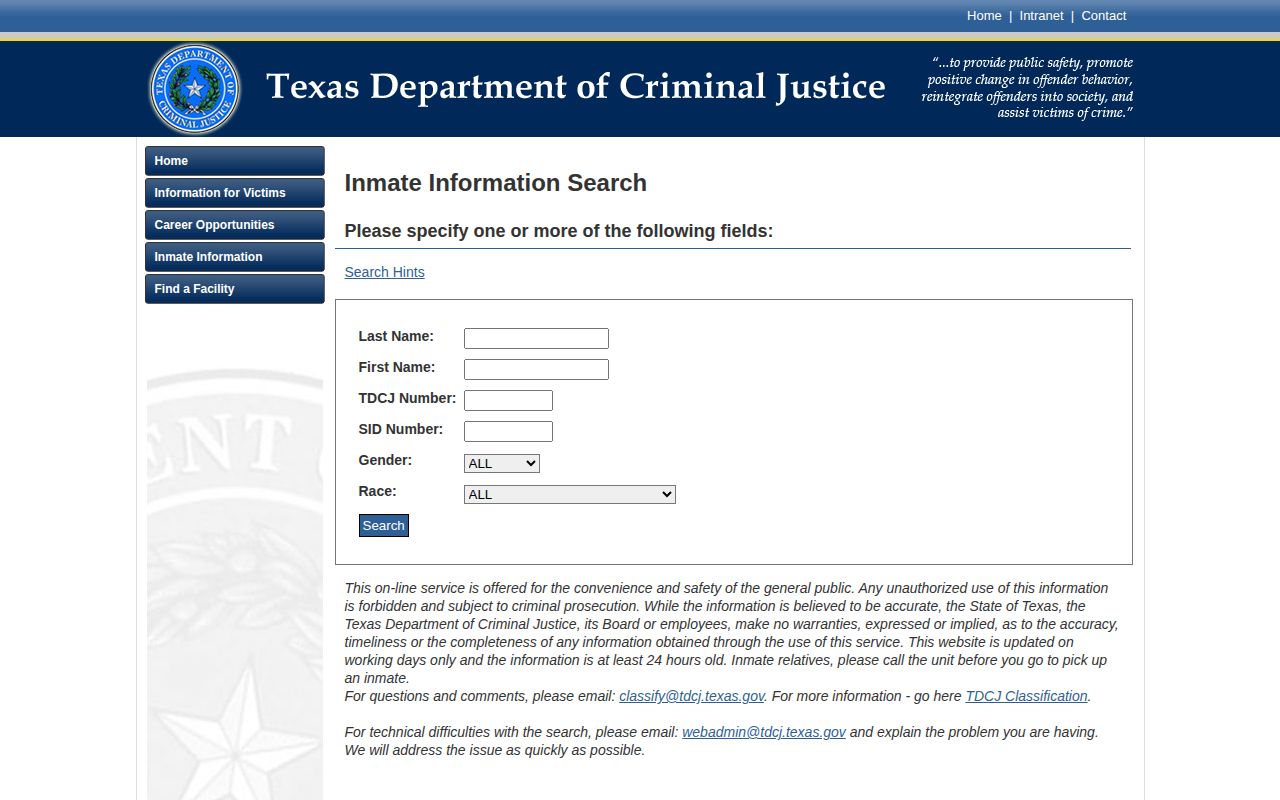
This form applies only when the custody path reaches TDCJ; it does not replace a Coleman County jail release record.
Coleman County Recent Release Limits
Coleman County does not publish an official feed labeled recent releases, released in the last 24 hours, or released in the last 72 hours. NetData's form has a beginning-date field, but its results are current custodial records. That field cannot honestly be used as a rolling release list. A selected current person's detail may preserve an older book-in and release row, which explains why one past episode can appear while another released person is absent.
No update cadence or former-inmate retention period is posted on the public interface. The page's system date does not prove real-time synchronization. For a recent event, call the jail and file a narrow request for release entries in an exact period. Separate community releases from transfers where the record permits. The dedicated Jail Releases: 24 Hours page explains that no same-day county feed exists and leads with these official fallbacks.
Coleman Release Supervision Checks
Texas splits supervision among distinct agencies. BPP decides parole and discretionary mandatory supervision. TDCJ Parole Division supervises those state releases. The Taylor, Callahan & Coleman Counties Community Supervision and Corrections Department handles court-ordered probation through its Coleman office. A jail release on bond does not create parole or probation unless a separate order does so.
- Parole
- Conditional release from TDCJ confinement before the sentence fully ends.
- Mandatory supervision
- A separate Texas release framework governed by offense date and eligibility rules.
- Probation
- Court-ordered community supervision that may occur without a state-prison stay.
- Discharge
- The official end of a sentence or supervision obligation.
Use the BPP status line before a parole decision and TDCJ Parole Division after a favorable vote. For probation, match the Coleman court docket with the local CSCD. Office assignment and private case details may not be public.
Coleman Release Alerts and Locators
Texas VINELink can supply person-specific status and event alerts when Coleman County or the reporting agency appears in the live portal. Search the matching record, check identifiers, and register through the channels offered on screen. A “released” alert means the reporting custody episode ended. It does not rule out a transfer or another active hold. TDCJ's Integrated Victim Services System is the stronger official notification channel for eligible TDCJ custody, parole, and mandatory-supervision events.
Federal and immigration cases require different tools. The BOP Inmate Locator may show a historical federal result with a release date. “Not in BOP custody” does not prove freedom from all custody or supervision. ICE's Online Detainee Locator System is mainly a current adult locator, and a missing result cannot confirm immigration release. USMS has no comparable public historical-release database. Use the federal court, holding facility, BOP, ICE field office, or proper USMS district contact based on the case.
Coleman Release Search by Custody
The right result depends on who held the person and at what point. A current locator cannot be treated as a release archive.
| System | What it can establish | Main limit |
|---|---|---|
| Coleman custody list | Who is displayed in local custody and details of a selected current record | Not a complete release feed or archive |
| Sheriff release or jail-register record | County release or transfer date and related booking facts | May require a written request |
| Coleman court record | Bond, dismissal, plea, judgment, sentence, or commitment | Order date may differ from physical departure |
| TDCJ online search | Current state-prison custody and projected fields | Released people disappear from the public locator |
| BOP locator | Current or historical federal custody result | End of BOP custody does not resolve all custody |
| VINELink or IVSS | Status-change notice for a matched person | Not a certified release record |
When systems conflict, use the source closest to the event. A jail release entry outranks roster absence. A receiving-agency record proves transfer. A court order establishes authority, while the jail timestamp shows when staff completed departure.
Correct a Coleman Release Record
Send a correction to the office that created the disputed field. Jail booking, release, bond, movement, and photograph details belong with the Sheriff's Office. A plea, judgment, dismissal, or sentence belongs with the County Clerk or District Clerk based on the case. TDCJ controls its own status, identity, and date fields. Start by obtaining the underlying record, then identify the exact field and provide the official document that supports the change.
The Coleman request form creates a written route to obtain the source first. It asks for a precise description, date range, delivery choice, and contact preference. A correction request should not ask one office to rewrite another agency's record. If the issue is an expunction or nondisclosure order, contact the issuing court and each covered custodian about the order's effect.
Coleman Court Records After Release
The Coleman County Clerk search instructions point users to Texas Online Records for County Court criminal matters and state that staff will not perform searches that statute does not require. Search by a precise name or cause number, then request a named filing when online access is incomplete. Felony dispositions remain with the District Clerk. Misdemeanor records ordinarily follow the County Clerk route.
Useful fields may include the cause number, party, charge, filing events, plea, judgment, disposition, sentence, and docket entries. Those facts can explain why Coleman County custody changed, but they do not always record the physical jail exit time. Pair the court event with the sheriff's booking-out or release entry.
Visit the Coleman County Court case-search portal before comparing its entry screen.
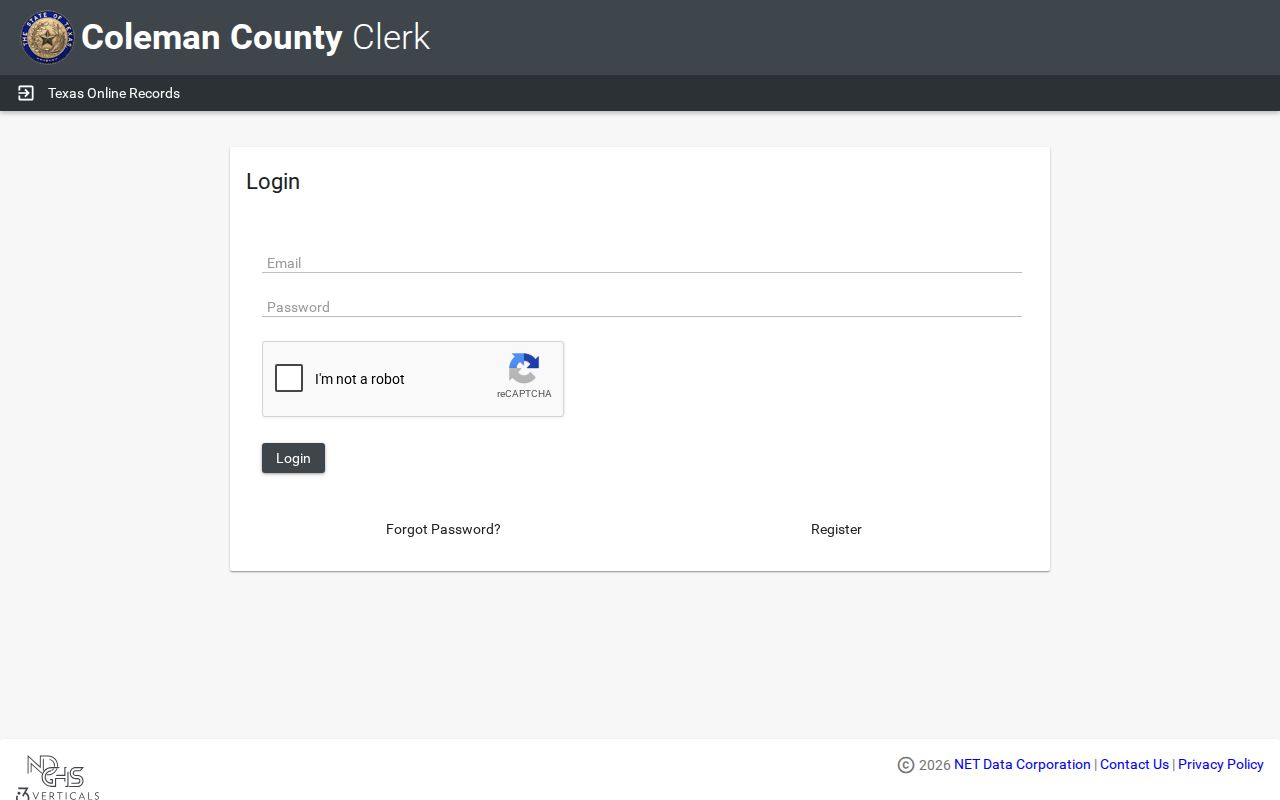
The court portal helps locate the legal case; the sheriff's record remains the source for the actual Coleman County release or transfer timestamp.
Avoid the Wrong Coleman Facility
The Gregory S. Coleman Unit is a geographic false positive. TDCJ places that prison in Lockhart, Caldwell County, not Coleman County. Its name does not make it a local detention facility. Official directories reviewed for this project identified no TDCJ prison, federal prison, ICE detention center, or separate regional jail inside Coleman County.
The county facility map should therefore center on the Coleman County Law Enforcement Center. If a future official directory adds a facility, use that agency's own custody and release system. Until then, a search result for “Coleman Unit” should not be mixed with a Coleman County released inmate inquiry.
Coleman County Release Facility
The Coleman County Law Enforcement Center is the sole verified local detention facility in the map. The Sheriff's Office operates it at 965 North U.S. 283 in Coleman. It holds people awaiting local court action, those serving qualifying county sentences, and people held for another authority.
A local departure may return someone to the community. It may instead send the person to TDCJ, another county, federal custody, immigration custody, or another holding agency. Confirm the outcome through the relevant booking detail, release or movement entry, court case, and receiving agency. The facility can be reached at 325-625-3506 for a booking-specific release or transfer question.
Note: Give the full name, approximate booking date, and arrest or cause number when asking the jail to identify one custody episode.