
Coleman County Release Processing
A favorable parole vote begins another stage. TDCJ Review and Release Processing checks the proposed residence, legal county-of-residence rules, disciplinary information, special conditions, required programs, and the release plan before a certificate can issue. The agency lists 512-406-5449 for that process. A planned Coleman County residence does not mean the Coleman CSCD office will supervise the parole case.
The official review and release page describes the checks that separate approval from departure.
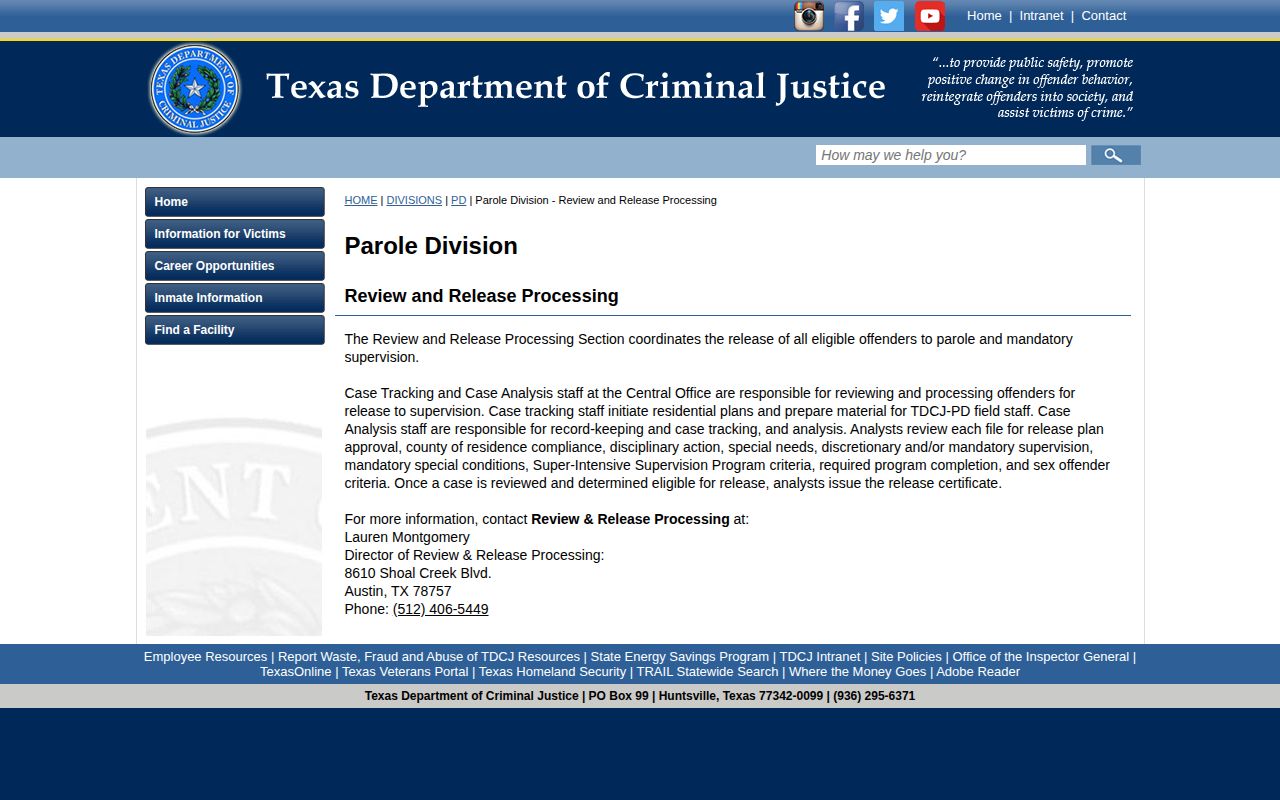
The processing screen supports a careful status sequence: vote, release-plan review, certificate, physical release, supervision, and eventual discharge. When a date matters, ask which stage the record actually proves.
Coleman County Parole Versus Probation
Texas assigns these forms of supervision to different authorities. The Texas Board of Pardons and Paroles, or BPP, decides parole and discretionary mandatory-supervision cases. The TDCJ Parole Division then supervises a person released from state confinement. A court imposes probation, while the Taylor, Callahan & Coleman Counties Community Supervision and Corrections Department manages the local order. Release on bond from the Coleman County Law Enforcement Center creates neither status by itself.
That split matters when a name vanishes from the Coleman County custody list. The person may have returned to the community, transferred to TDCJ, or moved to another agency. Only the court order, TDCJ status, or release record identifies what followed.
| Point | Parole | Probation |
|---|---|---|
| Source | BPP release decision after a prison sentence | Court community-supervision order |
| Supervisor | TDCJ Parole Division | Local CSCD |
| Best public proof | TDCJ/BPP status and release records | Court docket and CSCD confirmation |
| End point | Official discharge or sentence end | Court-ordered completion or discharge |
- Parole
- Conditional release from state confinement while the sentence remains active.
- Probation
- Court-ordered community supervision, often without a prior state-prison release.
- Mandatory supervision
- A Texas release category governed by eligibility law and, for many cases, BPP review.
- Discharge
- The official end of the sentence or supervision duty, not just release from a cell.
Verify Coleman County Post-Release Supervision
Begin with the sentence and custody system. The Coleman County jail roster is designed for current county custody. It does not act as a parole or probation directory. The TDCJ online search also has a strict boundary: it lists people currently confined in a TDCJ facility and is at least one working day old. Once confinement ends, the public result can disappear even while parole continues.
- Check the Coleman County court docket for the charge, judgment, sentence, and any community-supervision order. Use the County Clerk route for County Court criminal matters and the District Clerk for felony cases.
- For a state-prison case, use the TDCJ offender search while the person remains confined. Match the TDCJ or SID number, date of birth, offense, and county of conviction.
- Before a parole vote, call the BPP status line at 844-512-0461. A favorable code is an approval stage, not proof that the person physically departed.
- After a favorable vote, use the Parole Division release-status line at 512-406-5202 and confirm the assigned office through the current directory.
- For probation, confirm the judgment with the court and contact the Coleman CSCD office. Public access may confirm the order without disclosing private reporting details.
The complete Coleman County released-inmate search and county release-record path is available on the home page. Pair that record with supervision proof when the custody destination is unclear.
Coleman County Supervision Offices
Coleman probation has a local reporting office. State parole uses a separate regional assignment. The official county-to-office material maps state parole supervision to the Abilene District Parole Office in Region V, but assignments can change. Confirm the office before travel and do not assume a probation address serves a parolee.
Coleman CSCD Office
100 West Live Oak
Coleman, TX 76834
325-625-4125
Call for office hours and reporting instructions.
Abilene District Parole Office
5241 West Stamford Street
Abilene, TX 79603
325-672-1495
Fax: 325-734-5188
An office can verify routing and explain its public procedures. It may not release an officer's identity, confidential case notes, a reporting schedule, or protected personal details. Bring a reliable identifier when asking about a public status.
Coleman County Parole Review Status
Texas does not hold a formal public parole hearing for an individual case. BPP members review the file and vote. TDCJ identifies cases before eligibility, an institutional parole officer prepares a summary, and a three-member panel reaches a decision through matching votes. A denial can set another review date. An approval may impose conditions and can still be withdrawn if new information changes the case.
The BPP parole-panel FAQ explains why there is no Coleman County hearing calendar. The image below captures that official distinction.
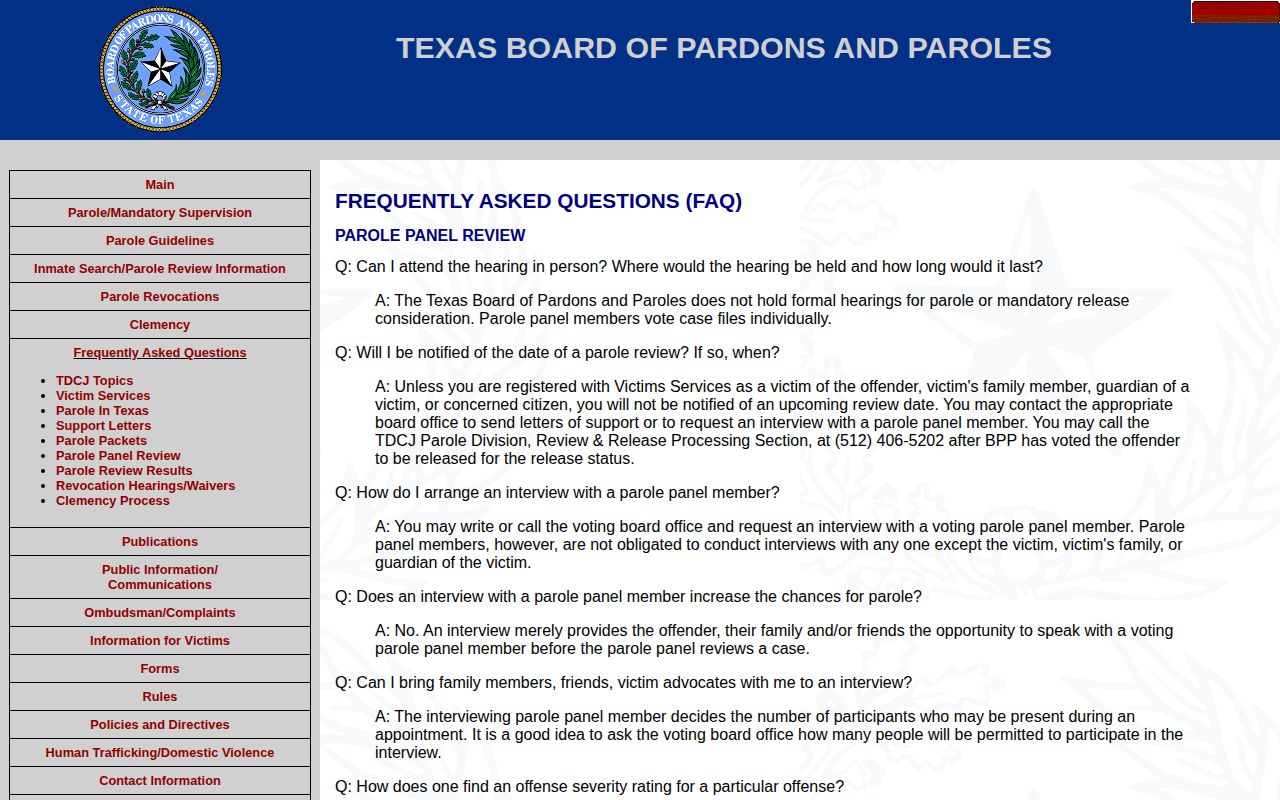
The lack of a courtroom-style event makes the person-specific TDCJ and BPP status routes more useful than a meeting calendar.
Vote codes also need care. FI-1 generally means release when eligible, while FI-2 points to a stated month and year. Other favorable votes can require a program. Denial codes can set later review or require service of the remaining term. The official BPP vote-options page defines each current code. None is a county jail release timestamp.
Coleman County Warrants and Violations
Supervision conditions come from the controlling order and agency. Common requirements may concern reporting, residence, travel, programs, or conduct, but the exact terms must come from the person's paperwork. A public case page rarely shows daily compliance. It should not be used to infer a violation from silence.
An alleged new offense, absconding, or breach of a release condition may lead to a warrant. An absconder is a person alleged to have stopped required contact or left supervision without authorization. A Coleman jail entry described as a blue warrant points to a parole-process hold. It is not a new conviction and does not prove that BPP has revoked parole.
Confirm the warrant through TDCJ Parole Division, BPP, and the relevant hearing or court record. VINELink may report a new custody event if the holding agency participates, but an alert does not decide the supervision case. Revocation can return a person to confinement; other outcomes can modify or continue supervision.
Correct Coleman County Supervision Records
A wrong release or supervision field should go back to its source. Send jail booking and release errors to the Coleman County Sheriff's Office. Direct a mistaken plea, judgment, or disposition to the proper court clerk. TDCJ must address its own custody, projected-date, parole, and discharge information. Changing one source does not automatically repair every copy elsewhere.
Coleman County's Public Information Request Form provides a useful first step when the underlying jail record is needed. Identify the person, narrow the booking and release dates, name the exact entry, and state whether inspection or copies are sought. Ask for an existing document rather than asking the custodian to create an explanation.
Preserve the source URL, search date, record number, and disputed field. A court order may explain why custody ended, but the jail release entry proves the time staff completed the event. Likewise, a favorable BPP vote supports approval, while the TDCJ release record confirms departure.
Coleman County Supervision Discharge
Release from confinement and discharge are different milestones. A parolee or person on mandatory supervision remains under a sentence after leaving a TDCJ unit. Probation continues until the court-recognized completion, discharge, revocation, or other lawful end. A jail release on bond may leave a criminal case pending without creating either type of post-release supervision.
For state parole, use the TDCJ or Parole Division record that states the final status. For probation, obtain the court docket entry or discharge order and confirm its meaning with the clerk or CSCD. Texas Government Code Chapter 508 governs key parole, mandatory-supervision, and revocation rules. The law is case-specific, so an eligibility date or maximum-expiration field should not be restated as final discharge.
A sound conclusion names the source and stage: approved for parole, scheduled for release, released to supervision, or discharged. Those phrases are not interchangeable. That care is essential when connecting a Coleman County custody record to what happened afterward.